What Is Domain-Driven Design?
Domain-Driven Design (DDD) is an approach to software development that puts the business problem at the center of the software design process.
Note: When we talk about design in Domain-Driven Design, we are not referring to graphical design, nor user interfaces or visual styling. We are talking about software design: how a system is structured, how responsibilities are divided, how code is organized, and how the architecture reflects the business it supports.
Originally introduced by Eric Evans in 2004, DDD has been practiced for over two decades as a way to tackle complex domains and long-lived systems.
At its heart, Domain-Driven Design brings business experts and software professionals together to collaboratively design software that reflects how the business actually works. Instead of treating requirements, architecture, and implementation as separate phases, DDD unifies them into a single process.
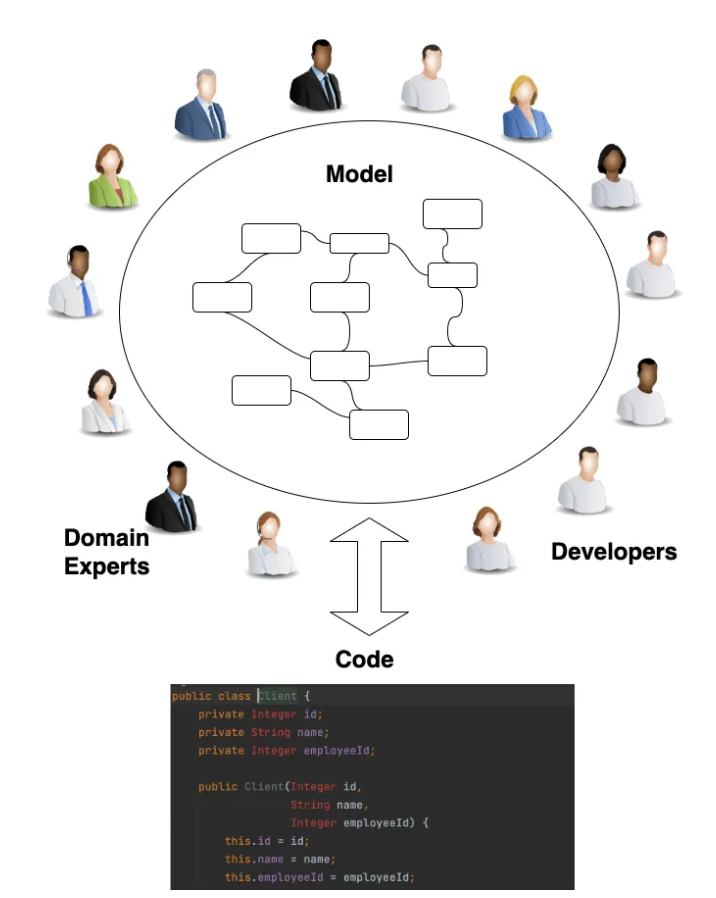
Teams work together to explore the problem domain, build a shared understanding, and express that understanding as a domain model. This model captures the key concepts, rules, and behaviors of the business and serves as the foundation for structuring the system: defining boundaries, organizing code, and shaping architecture. Crucially, the model is developed in a way that can be directly implemented in software, ensuring that business knowledge is not lost in translation.
The result is software that is easier to understand, easier to change, and better aligned with real business needs. Domain-Driven Design does not prescribe a specific architecture or technology. Instead, it provides a set of principles, practices, and collaboration techniques that help teams design systems that can evolve over time.
In short, DDD is not about documentation or theory for its own sake. It is about making deliberate software design decisions based on a deep, shared understanding of the problem you are solving.
Our courses help teams adopt Domain-Driven Design through practical workshops—showing them how to turn business insights into robust, maintainable software architectures.
Why Domain-Driven Design Matters?
Most software challenges are not caused by technology choices. They are caused by misalignment between what the business needs and the software built to support it.
Projects fail and run late not because teams cannot code, but because assumptions turn out to be wrong. This is mainly happens because knowledge of the business is fragmented across documents, meetings, and individuals. If requirements are misunderstood, over time, systems become harder to change, innovation slows, and the cost of every new feature increases.
Domain-Driven Design directly addresses these problems.
DDD creates a shared understanding between business and technical stakeholders. By establishing a common language and collaborative design process, The DDD process helps to catch misunderstandings early—when they are cheapest to fix—rather than late on in the development process, when they are significantly more expensive to fix.
From a strategic perspective, DDD helps organizations manage complexity. It provides a structured way to break large systems into cohesive, loosely-coupled parts aligned with business needs. This leads to architectures that scale not only technically, but organizationally—allowing teams to work more independently.
The benefits of adopting DDD are tangible:
- Lower risk through early validation of assumptions
- Faster time to market by reducing rework and architectural churn
- Improved collaboration across business and technical roles
- Systems that evolve with the business rather of becoming an obstacle to growth.
Domain-Driven Design is not a silver bullet, and it does not replace good engineering practices. What it offers is something more valuable: a way to ensure that investment in software results in systems that support the business today—and can still be changed tomorrow.
In an environment where adaptability is a competitive advantage, DDD is not a luxury—it is a strategic capability.
See the list of our courses